
Why can’t we just be kind?
#BeKind is by women and against women - but those who demand genuine kindness from women still use it against them

Are female students just nicer and kinder than male ones? In The Myth of Mars and Venus, Deborah Cameron explores the way in which certain typically ‘feminine’ ways of communicating and behaving may not necessarily demonstrate more innate ‘niceness’ on the part of girls. Rather, being viewed as ‘the nicest’ – the kindest, the most empathetic – can be way for girls to achieve the same thing boys do via more directly aggressive tactics: status:
“Girls are no less competitive than boys (and their peer groups are no less hierarchical); but the ideological opposition between femininity and power gives them less freedom to ‘jockey for status in an obvious way’”.
This rings very true to me. I know women and girls who’ve been good at performing niceness as one aspect of performing femininity – and as with all femininity, there’s an artificiality to it. I don’t really feel it, but I want to be seen as it. There have been times when I’ve tried this myself. Actually being kind is less rewarding, at least in terms of any status boost. A woman’s kindness is one of those things which, to quote Katrin Marçal, is “just a logical extension of her fair, loving nature”. It isn’t valued when it’s real.
When the actress Olivia Colman decided to hold forth on “transphobes”, the ‘kindness’ seemed to me to fall clearly into the performative, artificial category: cost-free, status-boosting, lacking in any analysis or justification:
“It’s really important to tell everyone’s story and to do it from an empathetic point of view … Stories can, even if it’s in a small way, change people’s perceptions sometimes for the better. But then someone who is anti-trans and against trans rights is someone who – I don’t know how you explain to them what understanding and kindness is. And now I don’t know what’s the right way to do it.”
The false bewilderment is a giveaway. She is baffled – baffled! – as to how some people can be so far removed from ordinary human “understanding and kindness”. That is how much better than them she is.
To be fair, Colman does not spell out what she means by “anti-trans” and “against trans rights”. Perhaps she genuinely does mean someone who wishes to discriminate against trans people, as opposed to someone who merely holds the core beliefs Jenny Lindsay expresses in Hounded:
“Women are materially definable as a class of human being […] Women (as adult female humans) are culturally, legislatively and politically important, with their own sets of needs, rights and concerns […] Where social, cultural or legislative trends are under way – ones that may diminish women’s rights and/or liberation – then women have a right to meet and discuss freely that which affects their lives profoundly.”
Maybe Colman is okay with all that (though I doubt it). But even if she means people with genuinely discriminatory views, there’s something deeply unsettling about advertising your total inability to comprehend them. It reminds me of the way in which people think of past atrocities and always picture themselves in the role of victim or saviour, never perpetrator or bystander who did nothing. You have to be able to entertain the possibility that you could have been the baddie (something so many who share that Mitchell and Webb clip seem not to grasp). You have to consider whether, rather than you being too off-the-scale kind to understand the meanies, there may be something you have missed.
Really, though, I suspect by “someone who is anti-trans”, Colman means someone who questions trans activist demands in any way. In her environment, to do so means risking a significant drop in status. This means empathy must be switched on to some people, switched off for others. In his book Against Empathy, the psychologist Paul Bloom describes empathy as “a spotlight focusing on certain people in the here and now”:
“[…] spotlights only illuminate what they are pointed at, so empathy reflects our biases. […] It’s a spotlight that has a narrow focus, one that shines most brightly on those we love and gets dim for those who are strange or different or frightening.”
I know that some would argue that trans people are “strange or different or frightening” and that therefore putting the needs of trans identified men before those of gender critical women is actually an overcoming of self-interest. I don’t think this is remotely true in the privileged spheres in which Colman operates. Working-class nurses or female prisoners are more strange, different and frightening – more low-status, less worth supporting – than the likes of Eddie Izzard or your actor friend’s non-binary child. “Whether or not you feel empathy,” writes Bloom, “depends on prior decisions about who to worry about, who counts, who matters – and these are moral choices.” It’s not enough to tell everyone how much you are feeling – who are you feeling it for, and why?
**
Yet kindness – in a true, non-performative sense – still matters. Whether most women are ‘naturally’ kinder than most men is difficult to prove. What is certainly true is that girls are conditioned to be more selfless, empathetic and giving than boys. There is a double standard in terms of expectations.
Not only that, but as Carol Gilligan noted in In A Different Voice, “the very traits that traditionally have defined the ‘goodness’ of women, their care for and sensitivity to the needs of others, are those that mark them as deficient in moral development”. Today we see a very clear example of this in right-wing men’s attacks on liberal women’s supposed “suicidal empathy” (some may well include Colman in this).
Conservative men who believe very much in ‘essential differences’ between women and men – in women being soft, gentle, compliant, men being hard, aggressive, dominant – have found a way to use “woman as empathiser” (as they would very much like her to be) to justify the sidelining of women in politics (because she’s too empathetic – suicidally so!). These overly empathetic women are putting women’s – their own! – safety at risk by refusing to embrace right-wing men’s overtly racist methods of ‘protecting women’ from other men (but not, you understand, themselves).
You see the double bind women face. Some early feminists sought to capitalise on the idea that women were kinder than men by suggesting this was the reason to grant them greater involvement in public life. Women’s emancipation, wrote Frances Power Cobbe, was “a means, a very great means, of doing good, fulfilling our Social Duty of contributing to the virtue and happiness of mankind, advancing the kingdom of God”. No self-interest in play here! Except men who believe ‘masculine’ qualities to be essential to access power are unlikely to fall for it, even as they impose ‘feminine’ qualities on women. Women must be feminine, but institutions that matter must never be ‘feminised’.
“Much of traditional morality in our society,” wrote Mary Daly, “appears to be the product of reactions on the part of men— perhaps guilty reactions— to the behavioural excesses of the stereotypical male”:
“There has been a theoretical one-sided emphasis upon charity, meekness, obedience, humility, self-abnegation, sacrifice, service. Part of the problem with this moral ideology is that it became accepted not by men but by women, who hardly have been helped by an ethic which reinforces the abject female situation.[…] A mark of the duplicity of this situation is the fact that women, who according to the fables of our culture (the favourable ones, as opposed to those that stress the “evil” side of the stereotype) should be living embodiments of the virtues it extols, are rarely admitted to positions of leadership.”
Women’s “goodness”, argued Daly, was also treated as a “tragic flaw”, confining them to “moral imbecility”. I think the link between this (written in 1973) and current complaints about women’s empathy supposedly having corrupted politics, HR departments and academia are obvious.
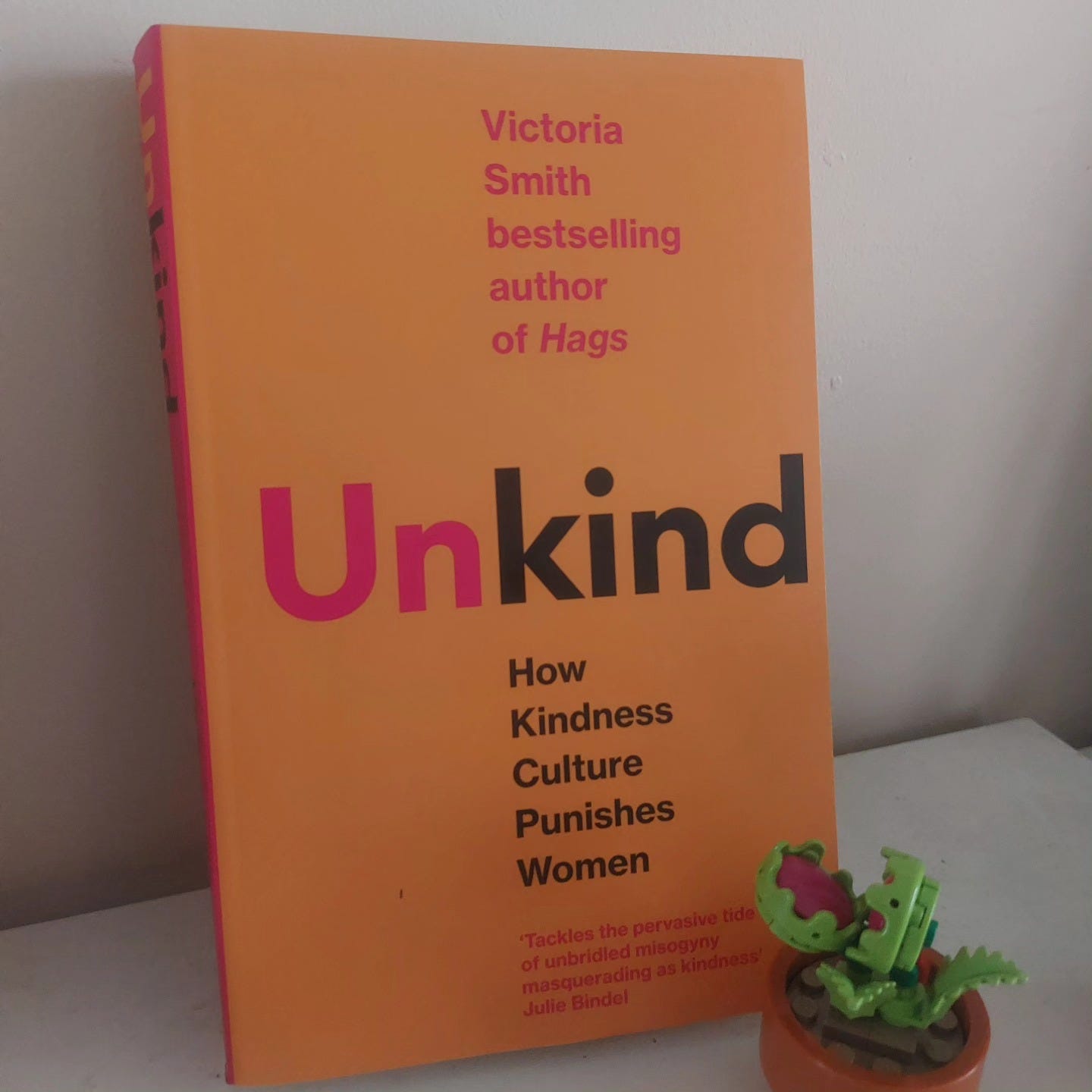
It’s not that I don’t think some #BeKind rhetoric is a problem – I’ve written a whole book on it (paperback out 6th March!). But there is a distinct (one might say deliberate) failure to distinguish between the type of ‘kindness’ that is ambition and status-boosting in disguise, and that which arises from an understanding of relationality and mutual dependency – the latter being the sort upon which our economies and social structures depend, but for which women receive little reward or recognition. The world would fall apart without this form of kindness, which is a challenge to any individualistic, non-relational politics (whether this be the I am whoever I say I am of capitalism or that of ‘progressive’ identitarianism).
It’s ironic to see male violence and predatory behaviour become a focal point of justifications to exile not men, but women from political discourse and campaigning, on the basis that some women ‘let’ men from the ‘other side’ do whatever they want. It is insincere and opportunistic. There is nothing “suicidally” empathetic about the performative kindness which allows some women to push others into the firing line, nor is there anything irrational about the genuine empathy which drives some women to put their own selves on the line for the sake of others.
In both cases, though, it makes no sense to talk of suicide when women are not killing themselves. It is men killing women. No women, however sincere or performative, ‘enable’ this. Only men can choose to do it.
VS: Why can’t we just be kind?
#BeKind is by women and against women - but those who demand genuine kindness from women still use it against them
Good question. And good points.
Apropos of which:
Substack, Dysmemics; Paula (Sexy Isn't Sexist) Wright: As readers of this blog know, I’ve long argued that female intrasexual competition is the pink elephant in the feminist room, and that feminism itself shows zero duty of care towards women—only towards feminists.
https://www.paulawrightdysmemics.com/p/endemic-female-intrasexual-competition?utm_source=post-banner&utm_medium=web&utm_campaign=posts-open-in-app&triedRedirect=true
Many feminists seem rather akin to Queers For Palestine, only stop shooting themselves in the feet to reload.
Moot as to the reasons behind that, though identity politics springs to mind, notably in making sex an "immutable" identity instead of a label for a transitory reproductive ability.
But, more broadly, there seems as many interpretations of sex and gender as there are feminists -- not quite as bad as Christian sects (38,000), but getting closer -- 23 at last count which is rather risible in itself apart from any substance they might bring to the table.
I have no doubt as to the value of the distinction between sex and gender which feminism is largely responsible for (circa 1945) and for which it deserves some credit. Although the OED gives some evidence of it going back some three hundred to six hundred years. But the devils are in the details, and much of feminism is a bloody joke -- reduced to risible absurdities as another TERF-Islander, Kathleen Stock, once put it:
https://kathleenstock.substack.com/p/feminist-reboot-camp?utm_campaign=posts-open-in-app&triedRedirect=true
In particular, there are as many interpretations of "gender" as there feminist sects. I kind think yours is closer to the mark, to some scientific justification, than most, but still somewhat short. Though I was planning a criticism of Konstantin Kissin's own views on the topic -- which you had highlighted in your recent "Pencil Feminism" post.
But as a -- somewhat flawed -- synthesis of your thesis and his "antithesis" -- which has many more holes in it than yours does -- you might consider a review, by US biologist Jerry Coyne, of a recent article in the San Francisco Chronicle by a pair of transwomen, one the well-regarded evolutionary biologist Joan Roughgarden:
QUOTE; JC: First, they agree that sex is defined by gamete size, something that Roughgarden, to [his] credit, has always admitted:
SFC: Zoologists, botanists, ecologists and evolutionary biologists generally define sex in this way: males make small gametes (sperm), females make large gametes (eggs) and hermaphrodites, such as most plants and many marine animals, make both.
JC: But they also claim that every trait other than gamete size is not part of sex but is part of gender:
SFC: Beyond gamete size, everything else — including secondary sex characteristics, body size, shape, color, behavior and social roles — is gender. UNQUOTE
https://whyevolutionistrue.com/2025/11/20/joan-roughgarden-and-jaimie-veale-on-sex-and-gender/
SFC: https://www.sfchronicle.com/opinion/openforum/article/trans-gender-sex-female-male-21125145.php (paywalled);
SFC; Archive link: https://archive.ph/KluWD
Somewhat more technically and accurately, it’s not just any physiological or psychological trait that gets to qualify as a gendered one, as a either a feminine or masculine one. For example, our hearts, lungs, kidneys, and other organs don’t qualify as either masculine or feminine – as either of the two gender TYPES – since they’re not any more common to males than to females. Part and parcel of the durable concept of sexual dimorphism.
https://www.thehelenjoyce.com/p/the-hidden-toll-of-genderism/comment/195631244
Though still moot as to which traits are joined at the hip with what it takes to qualify as male and female -- to a first approximation, testicles and ovaries, respectively. A question of nature, nurture, or a combination. But seems a useful framework, a way off the horns of a problematic social dilemma.